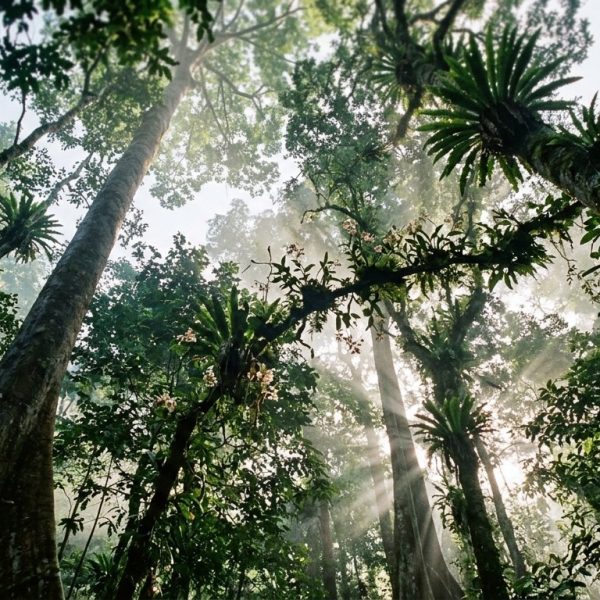
Walk into a lowland forest in Borneo just after dawn and the first thing that registers is not an animal. It is the weight of green overhead. Rainforest plants form the scaffolding that everything else in the system hangs from, and for an orangutan that scaffolding is not scenery. It is the floor, the ceiling, the pantry and the nursery, all at once. When conservationists talk about saving apes, what they are really defending is a botanical structure that took thousands of years to assemble. You cannot drop an ape into a patch of cleared ground and call it saved.
A Forest Is a Building, Not a Backdrop
Tropical lowland forest in Southeast Asia is dominated by the dipterocarps, a family of giant hardwoods that push above everything else and hold the canopy together. Beneath them sit smaller trees, palms, gingers, climbing rattans and an entire second world of plants that never touch soil at all. Orchids, ferns and mosses live on branches sixty metres up, fed by rain and dust. Strangler figs begin life as a seed dropped in a fork of bark and finish as free standing towers after the host tree rots away inside them.
This layering is why tropical rainforest plants support so much animal life in so little ground area. Each storey offers a different microclimate, a different fruiting season, a different set of escape routes. Remove the emergent trees and you do not simply lose timber. You lose the bridges, the shade and the flowering schedule that everything below was built around. The dipterocarp family alone accounts for a large share of the canopy across Borneo and Sumatra, which is precisely why selective logging of a handful of species can unstitch a whole hillside.
The Canopy Works as a Pantry
An orangutan spends most of its waking hours eating or looking for something to eat, and the menu is almost entirely botanical. Figs are the backbone, partly because different fig species fruit at different times and rarely leave a gap. Around them sit durians, rambutans, wild lychees, young leaves, bark, pith and the occasional handful of termites.
The complication is mast fruiting. Across much of Borneo, dipterocarps synchronise and flower heavily only once every few years, often triggered by drought. In a mast year the forest floods with food. In the long stretch between, animals live on the reliable species, which is another way of saying that the plants nobody would plant for profit are the ones keeping apes alive in lean seasons. Any replanting scheme that ignores that calendar produces a forest that looks convincing in photographs and starves wildlife in practice.
Why Rainforest Plants Fail Before the Animals Do
Habitat collapse rarely starts with a dramatic clearance. It starts with a road, then selective logging of the biggest trees, then drying at the forest edge, then fire in an unusually hot year. By the time ape numbers fall sharply, the vegetation has already been in trouble for a decade. The IUCN Red List assessment for the Bornean orangutan tracks exactly this pattern of habitat loss and fragmentation rather than a single catastrophic event.
There is a feedback loop too. Orangutans and hornbills swallow fruit and carry seeds for kilometres before depositing them. Take out the large fruit eaters and the heavy seeded trees stop travelling. The forest keeps standing for a while, then quietly stops regenerating.
Replanting Is Slower and Fussier Than It Looks
Serious reforestation projects do not begin with saplings. They begin with seed collection from surviving stands, shade nurseries, soil work on degraded land and several years of weeding before anything is left to fend for itself. Survival rates in the first two years are the number that actually matters, and they are unforgiving on compacted ex plantation ground.
The record keeping behind this work is heavier than most donors imagine. Field teams write plot notes in Indonesian or a local language, botanists file species names in Latin, and funders in Europe and North America need the whole thing in a language they can audit. Getting that chain right is unglamorous but load bearing, and groups that invest in proper scientific translation of their monitoring data end up with a far more defensible case when they apply for the next round of funding.
Something similar is happening to the human knowledge around the forest. The communities living alongside these landscapes carry plant names, seasonal indicators and medicinal uses that exist in no herbarium, and many of those languages are themselves thinning out. The parallels between endangered and dead languages and endangered species are not merely poetic. Both are archives that fail quietly, and both are far cheaper to hold onto than to reconstruct.
What Actually Helps From Several Thousand Miles Away
Three things, in rough order of usefulness. First, fund restoration that publishes survival data rather than planting totals. A million seedlings in the ground is a press release. Sixty per cent alive at year three is a forest. Second, read labels with a little more suspicion, since palm oil, pulp and tropical timber all trace back to the same few landscapes. Third, support the community forestry and patrol work that keeps standing forest standing, which is always cheaper than replacing it.
It is worth resisting the urge to see this as hopeless. Degraded land does come back when it is given native species, time and someone to keep the weeds off. Orangutans have been recorded moving back into restored corridors within a decade. The species is slow to breed and slow to recover, but it is not fragile in the way people assume. What it needs is the same thing the plants need, which is somewhere to stand that nobody is about to clear.
Protecting rainforest plants is not a side project within conservation. It is the whole job, dressed in less charismatic clothing. The apes are simply the part of it that looks back at you.