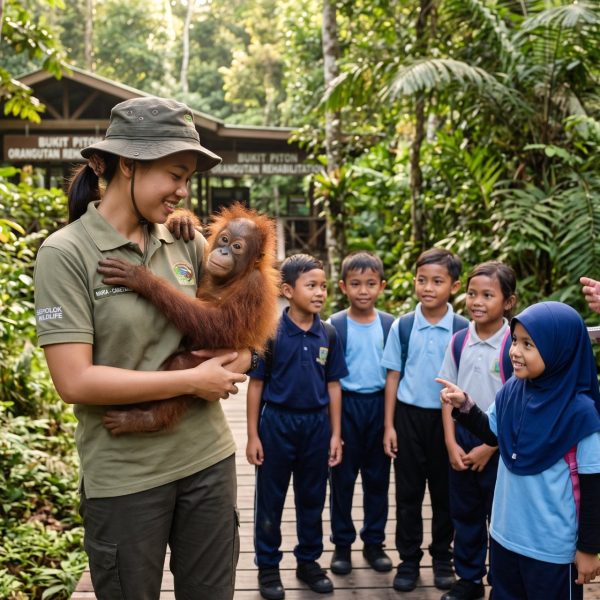
Saving Orangutans Starts in a Classroom, Not Just a Rainforest
Most people picture orangutan rescue as a dramatic scene: a sedated animal lowered from a dying tree, carried to safety by a team in muddy boots. That work is real and it matters. But the rescuers will tell you the quieter victories happen somewhere less photogenic, in village meeting halls and school rooms at the forest edge.
Conservation groups learned a hard lesson over the past two decades. You cannot fence off a rainforest and hope it survives. The people who live beside it decide its future every single day. Education, not just enforcement, is what keeps a habitat standing.
Why Primates Became a Teaching Tool
Orangutans share close to 97 percent of their DNA with humans, and that fact does a lot of work in a classroom. Children who learn how similar these animals are tend to see the forest differently. The background on orangutans shows a species that is slow to reproduce and utterly dependent on old-growth trees, which makes every lost hectare costly.
The stakes are not abstract. All three orangutan species are listed as critically endangered, a status you can confirm on the IUCN Red List. That single word, critical, is the reason educational advocacy has moved from a nice extra to the center of most rescue budgets.
The Programs That Actually Change Behavior
Effective conservation education rarely looks like a lecture. The programs that shift behavior tend to share a few features:
- Local teachers who speak the community's own language and dialect
- Hands-on field trips to rehabilitation centers rather than slideshows
- Practical alternatives to slash-and-burn farming, taught step by step
- Materials that respect indigenous knowledge instead of overriding it
- Follow-up visits so the message does not fade after one assembly
Notice how many of these depend on communication. A brilliant curriculum written in English helps no one if it never reaches a teacher in rural Borneo in a form she can use.
The Language Problem Behind Global Conservation
A foundation working to save orangutans is almost never a single-country operation. Donors sit in Europe and North America. Field staff work in Indonesia and Malaysia. Scientists publish in one language, while the communities doing the daily protecting speak several others.
That gap is where good intentions quietly break down. A grant report, a training manual, a school curriculum, a legal agreement with a village cooperative: each one has to move between languages without losing its meaning. When the material is educational or academic, precision matters even more, because a confused lesson teaches the wrong thing.
This is why many organizations rely on professional academic translation services to prepare their teaching and research materials. A donor pitch can survive a rough edge. A curriculum used to train hundreds of local educators cannot.
The forest is protected by people, and people are reached through language they trust.
Palm oil is the clearest example of how a single ingredient links everyday consumer habits to a distant ecosystem. Once you start reading labels for it, the connection between shopping and conservation becomes concrete rather than abstract. That awareness is now one of the stronger forces shaping global food trends.
What Sponsorship Money Really Buys
When someone sponsors an orangutan online, they usually imagine their money buying food and veterinary care. It does. But a surprising share funds the educational side: printing bilingual workbooks, running teacher workshops, translating conservation science into plain local language, and building programs that outlast any single grant cycle.
Rescue treats the emergency. Education prevents the next one. Foundations that ignore the second half find themselves rescuing the same animals from the same threats, year after year, with no end in sight.
A Model Other Causes Are Copying
The orangutan movement did not invent conservation education, but it has refined it into something other campaigns now study. The core insight is simple and slightly humbling: outsiders do not save a habitat. They support the people who already live there, and they do it in that community's own words.
Habitat restoration projects have started measuring success not only in trees replanted but in how many local schools carry a conservation program. That shift changes how money flows. It rewards patient, unglamorous teaching over one-off publicity stunts.
It also demands humility from international staff. The best programs treat indigenous communities as partners with deep ecological knowledge, not as an audience to be lectured. Translation, in that context, runs both ways.
The Long Game
Orangutans can live into their fifties, which means a young animal rescued today may still be alive when the children in these classrooms have children of their own. Conservation on that timescale cannot rely on any single dramatic rescue. It relies on a generation growing up believing the forest is worth more standing than cleared.
That belief is built one lesson at a time, in the right language, by teachers the community already trusts. It is slow, it rarely makes the news, and it may be the only thing that works. Save the teacher, and you help save the species.