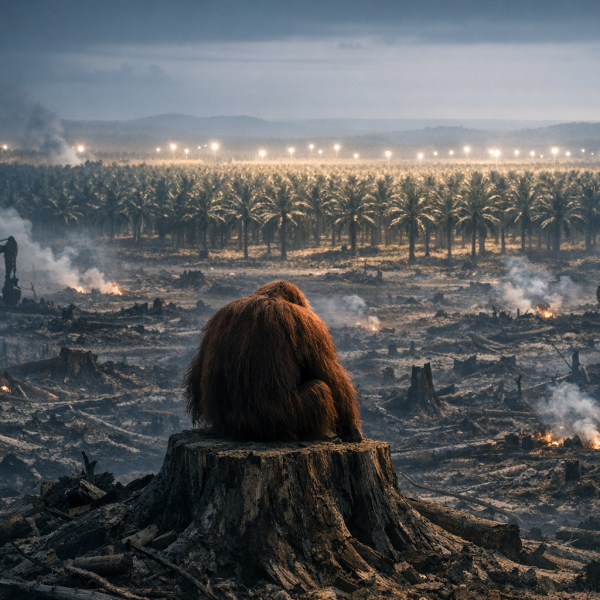
Across Southeast Asia, one of the world’s most intelligent great apes is being pushed to the brink as rainforests disappear at a staggering pace. The rapid expansion of industrial agriculture, especially for a single ubiquitous commodity, has transformed once-vast jungles into fragmented patches of land. This accelerating loss of habitat is forcing orangutans closer to human settlements, increasing conflict, and driving a silent biodiversity collapse that reverberates far beyond the forest edge.
1. How Monoculture Plantations Reshape Entire Landscapes
In regions once dominated by dense, biodiverse rainforest, industrial-scale plantations now stretch to the horizon. These monocultures eliminate the complex web of trees, vines, and undergrowth that orangutans depend on for food, nesting, and safe travel. What was once a layered, living ecosystem becomes a simplified grid of identical trees with poor food diversity and almost no shelter. With each clearing, orangutans lose more of the interconnected corridors they need to move, mate, and maintain healthy populations.
2. Fire as a Tool: Clearing Forests at Terrible Cost
To make way for plantations at low cost, companies and smallholders often resort to slash-and-burn practices. These fires are devastating to orangutans. Individuals can be trapped by fast-moving flames, suffocated by smoke, or forced into marginal patches of forest with little food. Peatland fires are especially destructive, burning underground for weeks and releasing enormous amounts of carbon while destroying the deep-rooted trees orangutans rely on. The thick haze that blankets entire regions during burning seasons is a visible sign of this hidden crisis.
3. The Hidden Supply Chains Behind Everyday Purchases
Many everyday products on supermarket shelves are linked indirectly to the destruction of orangutan habitat. Food, cosmetics, detergents, and packaged snacks often contain ingredients tied to large-scale plantations. Even businesses far removed from agriculture can unintentionally support destructive practices through complex supply chains and poorly tracked sourcing. Companies that aim to operate responsibly can start with better data and documentation. Using tools like a modern invoice generator ai helps track suppliers, orders, and certifications, creating clear paper trails that support ethical procurement and more transparent reporting.
4. Habitat Fragmentation: Islands of Forest in a Sea of Fields
Deforestation rarely happens as a single, clean cut. Instead, forests are chipped away, leaving behind small, isolated fragments surrounded by plantations and roads. For orangutans, these fragments function like islands. They may hold some food and nesting sites but are too small to sustain healthy, genetically diverse populations over the long term. Orangutans that attempt to cross open land in search of new territory or mates face higher risks of starvation, poaching, or conflict with humans.
5. Human–Wildlife Conflict on the Forest Frontier
When plantations replace natural forest, orangutans often enter these areas in search of food, especially when wild fruiting trees become scarce. Plantation workers may perceive them as pests and respond with violence, trapping, injuring, or killing them. Young orangutans are particularly vulnerable; some are captured for the illegal pet trade after their mothers are killed. While rescue centers do critical work rehabilitating survivors, reintroduction into the wild is limited by the shrinking availability of safe, intact forest.
6. Ripple Effects on Climate, Water, and Regional Stability
Deforestation does not only threaten orangutans; it destabilizes entire ecosystems and human communities. Forests act as carbon sinks, water regulators, and buffers against floods and landslides. When they are cleared, local climates become hotter and drier, rivers become more prone to flooding or drought, and soil erosion accelerates. These disruptions affect farming, fishing, and public health, making rural livelihoods more precarious. In many areas, social tensions grow as communities compete for dwindling fertile land and clean water.
7. Certification Schemes: Progress with Significant Gaps
In response to public concern, various sustainability certifications and industry pledges have emerged, promising deforestation-free or wildlife-friendly operations. While these initiatives have helped reduce the most blatant forms of forest clearance in some regions, they are far from perfect. Loopholes, weak enforcement, and inconsistent monitoring can still allow habitat destruction to continue under a sustainable label. Independent audits, robust traceability systems, and genuine transparency in reporting are essential if these programs are to offer real protection for orangutans.
Palm oil sits in an enormous share of household products, and cosmetics are one of the largest categories by volume. That is why so many people looking for natural beauty tips end up learning to read certification marks as well as ingredient lists. A skincare shelf is a supply chain decision most of us make without noticing.
Conservation work depends on legal instruments that cross jurisdictions, from land titles to import permits. Enforcement follows paperwork. NGOs operating internationally submit a steady flow of documents where a notarized translation is the difference between a filing accepted and refused.
8. Local Communities as Frontline Stewards
Indigenous peoples and local communities often have the deepest knowledge of forest ecosystems and the strongest cultural ties to the land. When they have legal recognition of their territories and meaningful decision-making power, deforestation rates tend to drop significantly. Community-managed forests can provide livelihoods through small-scale agroforestry, eco-tourism, and non-timber forest products while keeping critical orangutan habitat intact. Strengthening land rights and supporting locally driven conservation is therefore one of the most effective strategies for long-term protection.
9. Technology as a Tool for Monitoring and Accountability
Satellite imagery, drones, and real-time deforestation alerts are transforming how activists, researchers, and even consumers track forest loss. Conservation groups can now document illegal clearing within days, rather than months or years, increasing pressure on governments and corporations to act. Digital platforms that map concessions, supply chains, and protected areas give the public a clearer picture of who is responsible for habitat destruction. When combined with open data policies and strong investigative journalism, these tools can expose the links between land grabs, deforestation, and corporate profit.
10. What Individuals and Businesses Can Do Differently
Changing the trajectory of orangutan habitat loss will require a combination of consumer pressure, corporate responsibility, and policy reform. On an individual level, people can support products verified by strong environmental standards, reduce waste, and donate to credible conservation organizations that protect and restore forest corridors. Businesses, from small retailers to large manufacturers, can audit their supply chains, set clear zero-deforestation policies, and publish transparent progress reports. By demanding traceable, responsibly sourced ingredients and investing in forest-positive initiatives, companies can help shift the economic incentives away from destruction and toward protection.
From Rapid Loss to Real Protection
The crisis facing orangutans is not an inevitable byproduct of development but the result of choices about how land, resources, and profits are managed. Forests can provide economic value without being erased, and agriculture can expand in ways that respect both wildlife and local communities. The same global systems that currently reward rapid clearance can be reshaped to favor conservation, restoration, and long-term resilience. Every actor in the chain, from producers to processors, brands to buyers, has a role to play. By insisting on transparent sourcing, supporting community stewardship, and backing science-based conservation, it is still possible to secure a future in which orangutans and their forests not only survive but recover.